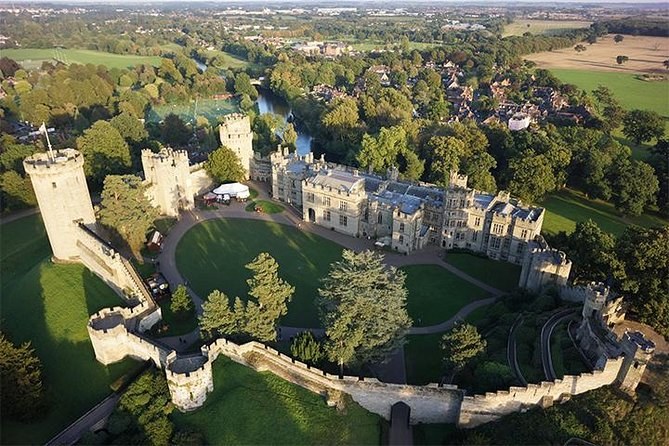
11 Facts About Warwick Castle That Will Surprise You
Short answer. The vase everyone photographs is a replica. The town’s defences are 154 years older than the Norman castle on them. An owner was murdered by his own servant. And the Great Hall you walk through burned down in a single night in 1871. Eleven facts, all of them checkable, none of them on the guidebook page.
1. The Warwick Vase is in Glasgow
The most famous object ever kept at this castle is no longer at it. The Warwick Vase was dug in fragments from the silts near Hadrian’s villa outside Rome in 1769 and 1770, restored in the early 1770s, and given to George Greville, Earl of Warwick. It stood here for close to two centuries. In 1979 it was sold to the Burrell Collection in Glasgow, where it still is. What stands at Warwick now is a replica.
2. The fortifications are older than the Conquest
Warwick was a defended town 154 years before the castle existed. Æthelflæd, Lady of the Mercians and daughter of Alfred the Great, raised a burh here in 914 as part of a chain against the Danes. The Normans chose this bend of the Avon because somebody else had already worked out it was the right one.
3. An owner was murdered by his own servant
Sir Fulke Greville, granted the castle by James I in 1604, was murdered in 1628 by his servant Ralph Haywood in a dispute over his will. It is the kind of thing that ends up in a ghost walk, and in this case it is simply what happened.
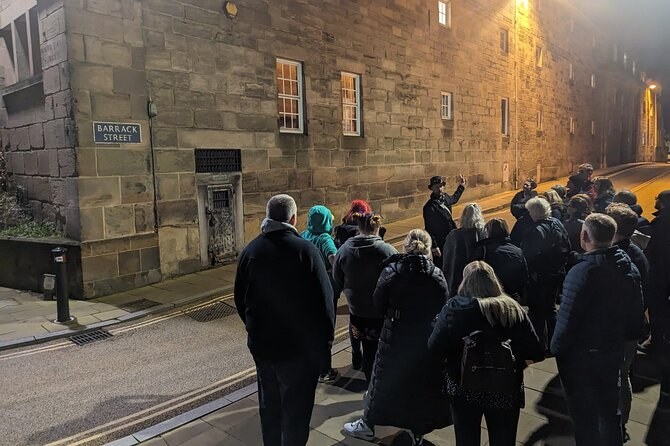
Did you know? An independent operator runs a ninety-minute evening walk round Warwick’s dark history that takes in the Lord Leycester, Mill Street and the castle gates. It does not go inside the castle — it stops outside the walls for about eight minutes — which is worth knowing before you book it.
4. The Great Hall you walk through burned down
Fire broke out in the early hours of Sunday 3 December 1871 in Lady Warwick’s apartments above the library, east of the hall. It destroyed the Great Hall and a number of private apartments and offices. Both were rebuilt. So the medieval hall a visitor walks through is Victorian work inside a fourteenth-century shell, and almost nobody who walks it knows.
5. The towers were paid for with French ransom money
Thomas Beauchamp, Earl of Warwick from 1329 to 1369, made his fortune in France largely by ransoming captured French nobles, and spent it here. Caesar’s Tower and Guy’s Tower — the two things every visitor climbs — were built with it.
6. The taller tower is not the bigger one
Caesar’s Tower is 40 metres and Guy’s is 29, and the difference is mostly ground level rather than building. Caesar’s starts from lower down the slope. It is the sort of fact that only becomes obvious when you have climbed both, which is exactly why the wall walk is worth the 540 steps.
7. A king was held prisoner here
Edward IV was held at Warwick, in Caesar’s Tower, by Richard Neville, 16th Earl of Warwick — the man who had put him on the throne in the first place. Neville made two different kings during the Wars of the Roses, which is where the name Kingmaker comes from, and he is the reason anybody outside Warwickshire knows this castle’s.
8. The lawns are by Capability Brown
Francis Greville commissioned Lancelot ‘Capability’ Brown to re-landscape the grounds and park between 1749 and 1757. The sight-lines, the placing of the trees and the way the courtyard reads as a stage set are his rather than the earls’. The work cost about £2,293 at the time.
9. One family held it for 374 years
The Grevilles were granted the castle in 1604 and sold it in November 1978. Five families held it in all — Beaumonts, Beauchamps, Nevilles, Dudleys and Grevilles — but the last of them managed almost four centuries, which is why the state rooms are furnished rather than empty.
10. It was besieged twice and taken once
In 1264, during the Second Barons’ War, forces loyal to Simon de Montfort took the castle and carried off William Mauduit, the 8th Earl. In 1642, in the Civil War, it was besieged again and held. Holding in 1642 is why so much fourteenth-century fabric survives: Warwick avoided the slighting that flattened comparable castles.
11. The Castle Dungeon is not in your ticket
The least romantic fact on this list and the most useful. The Castle Dungeon, which is the castle’s own live-actor scare attraction, is an additional charge from £10 a head, bought inside at the Courtyard Ticket and Information Office, and it is ten-and-over only. Admission and tickets sets out everything else that sits outside the price.
What you can actually see of each of these
Facts are better when you can put your hand on them, and most of these you can. Here is where you go for each.
- The replica vase. You will walk past it. Knowing it is a copy makes it more interesting rather than less.
- The 1068 mound. You climb it — 122 steps — and the burh of 914 is under the whole town you walked through to get here.
- Beauchamp’s ransom money. You are standing in it every step of the 540 up the towers.
- Edward IV’s prison. Caesar’s Tower, on the same wall walk.
- The 1871 fire. The Great Hall. Look at the roof, then at the exterior wall it sits in, and you can see the two dates.
- Capability Brown. The lawn you cross from the gate, and the way the towers are framed from it.
- Fulke Greville’s murder. Not marked, but you are in the right building for it.
Give yourself the whole day if you want all seven. Things to do has each one with its step count, and if you are coming from London, the day trips leave you about ninety minutes, which is enough for three of them.
Where each of these came from
| Fact | Date | Where it comes from |
|---|---|---|
| The burh at Warwick | 914 | The castle’s own interpretation |
| William’s motte | 1068 | The castle’s own history |
| The castle taken | 1264 | The castle’s own history |
| Beauchamp’s towers | 1329–69 | Warwick Castle, Towers & Ramparts |
| Fulke Greville murdered | 1628 | The castle’s own history |
| Capability Brown | 1749–57 | Contemporary accounts of the commission |
| The Warwick Vase excavated | 1769–74 | Glasgow Museums |
| The Great Hall fire | 3 December 1871 | Contemporary accounts |
| Sold to the Tussauds Group | November 1978 | The castle’s own history |
| The vase sold to the Burrell | 1979 | Glasgow Museums |
The full history puts all of it in order, and Warwick Castle day tour reach the castle from London if you would rather see it than read about it. Warwick Castle Tours sets them out side by side.
Eleven facts are a start. The 1068 mound under your feet is the rest.Every listing here refunds in full at 24 hours’ notice.
See Top ToursSee the evidence for yourself
Oxford, Stratford-upon-Avon and Warwick Castle on Boxing Day
Castle entry includedCoach travelGuide included
From $149 per person