Inside Warwick Castle: Every Tower, Hall and Garden
Short answer. Eleven named parts, in the order the castle’s own map walks them. Four of them have no step-free route and the towers alone are 540 steps. Do the climbing first, keep the flat ground for the afternoon, and the day works. Everything below is what is in each part and roughly what it costs you in time.
How the site is laid out
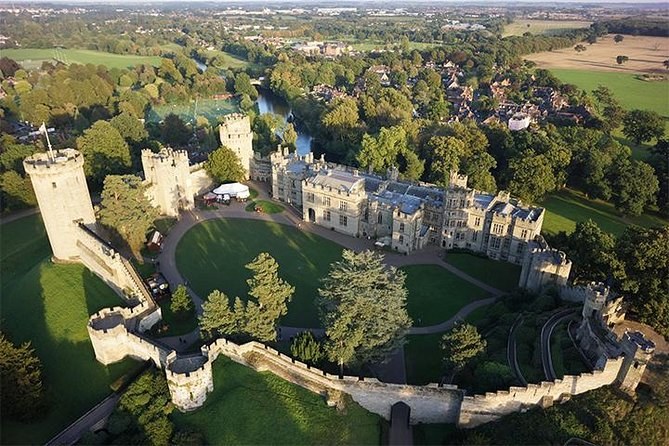
Warwick Castle divides into three zones and it helps to hold them in your head before you arrive. The courtyard holds the East Front, the Great Hall and State Rooms and the entrances to both towers. The mound and gardens sit to one side. The riverside is Pageant Field, the mill and the island.
Walk them in that order and you climb while you are fresh and finish on the flat. Walk them backwards and you will be attempting 540 steps at four in the afternoon. Guided Warwick Castle tour are set out with how long each one leaves you.
The East Front
The gatehouse and barbican you come in through, and the face of the castle everybody photographs from the courtyard lawn. Stand still for a minute before you move: from here the whole shape of the site is visible, and the rest of the day is easier to plan for it. Time: five minutes, and worth every one.
Caesar’s Tower, 40 metres
Caesar’s Tower is fourteenth-century work, and taller than Guy’s Tower because it starts from lower ground rather than because it is a bigger building. Edward IV was held here during the Wars of the Roses, which is a genuinely strange sentence to be able to write about a room you can walk into. Time: part of the 540-step route.
Guy’s Tower, 29 metres
Twelve-sided, built in the same century to lodge the earl’s guests, and the top is the reason most people climb at all. The view takes in the courtyard on one side and open Warwickshire on the other. Time: part of the same route, and the part people photograph.
The Towers and Ramparts route, 540 steps
The wall walk that links the two towers, and the single most important practical fact about this castle. There is no lift, no shortcut and no way down but back. The castle states plainly that it is not recommended for limited mobility, heart or respiratory conditions, or pregnancy.
Time: forty-five minutes to an hour, depending on how often you stop to breathe.
Do this first Everybody who leaves the towers until mid-afternoon says the same thing afterwards. If steps are a problem for anyone in your party, the accessibility page sets out a complete route through this castle with no steps in it at all.
The Great Hall and State Rooms
Arms and armour in the hall, then the rooms the Greville family actually lived in until 1978. The hall itself is a rebuild — the original burned in December 1871 along with the private apartments above the library — so what you are walking through is Victorian work inside a medieval shell. This is the only indoor highlight with a step-free route, by wheelchair lift. Time: thirty to forty minutes.
The Royal Weekend Party
The private apartments staged as a Victorian house party given by the Countess of Warwick, with the guests set out as though they had stepped into the next room. It is the most divisive thing here: some visitors call it the best part of the castle and others would rather have the empty rooms. You will know which you are within thirty seconds. Time: twenty minutes.
The Kingmaker, 33 steps
The Kingmaker is a walk-through of a medieval household arming for battle, built around Richard Neville, the 16th Earl of Warwick, who earned the nickname the exhibition takes its name from. The floor is cobbled throughout and there are 33 steps. The castle publishes a quiet hour between two and three in the afternoon, which is useful if crowds are the problem rather than stairs. Time: twenty minutes.
The Conqueror’s Fortress, 122 steps
The motte William the Conqueror raised in 1068, with an interpretation that reaches back past him to 914 and the burh Æthelflæd built here. The defences under your feet are 154 years older than the castle on them. Time: twenty minutes, and no step-free route.
The Peacock Garden and Pageant Field
Clipped yew, hedging and a fountain in the first; open riverside grass in the second. Both are flat, both are free of steps, and both are where you want to be after the towers. Pageant Field is also where the flying display is watched from, and there are no seats. Time: as long as the weather allows.
River Island and the Mill and Engine House
The island in the Avon holds the working siege machine and is the farthest corner from the entrance, which makes it the emptiest ground on a busy day. The Mill and Engine House sits below the walls by the water and covers the castle’s own machinery from fourteenth-century milling to the generator that lit the state rooms — and it has no accessible entrance. Time: twenty-five minutes for both.
Hidden things most visitors walk past
- The replica vase. The Warwick Vase left in 1979 for the Burrell Collection in Glasgow. What stands here now is a copy, and hardly anybody knows.
- The free History Talks. The castle’s own staff run them all day at no charge, and they are the closest thing here to a guided tour.
- The Beauchamp tomb, five minutes away. The earl who built the towers is buried in the Collegiate Church of St Mary in the town.
- The view from Mill Street. The best photograph of this castle is taken from outside the paying area.
What you can safely skip
Nobody sees all eleven properly in one visit, so the useful question is what to drop rather than what to add. If your day is short, the Mill and Engine House is the first thing to go: it is furthest from the entrance, it has no step-free access, and the view of the mill from the far bank of the Avon is the better photograph anyway.
The Horrible Histories Maze and Zog Playland are next, unless you are here with children, in which case they are the reason you came and something else goes instead. And if the towers are out for your party, drop the Norman mound too rather than spending 122 steps on the smaller of the two climbs — put the time into the Great Hall, the Royal Weekend Party and the gardens, which together make a full and step-free afternoon.
Photographing it
Three positions do most of the work. The courtyard lawn gives you the East Front with the towers behind it, and it is the shot on every guidebook. The top of Guy’s Tower gives you the courtyard from above, and it is the one nobody else in your party will have unless they climbed too.
The third is not inside the castle at all. Mill Street and Castle Bridge, five minutes from the gate and outside the paying area, give you the towers, the mill, the weir and the water in one frame. Go at the end of the afternoon when the light is on the sandstone, and take it after you have finished rather than before you go in.
A route that works
| When | Where | Why then |
|---|---|---|
| On opening | Towers and Ramparts | 540 steps on fresh legs, and empty |
| Late morning | Great Hall and State Rooms | Before the coach parties reach the indoor half |
| Noon | Pageant Field | The first flying display |
| Early afternoon | The Kingmaker | Its own published quiet hour is 2–3 |
| Mid-afternoon | The mound and the gardens | Flat ground, and the light |
| Late afternoon | River island and the mill | The emptiest part of the site by then |
Things to do has each part with its own step count, the shows page has the two clock times to plan around, and Warwick Castle Tours sets out every way in with how long it leaves you.
Eleven named things, 540 steps and one wall walk. Give it the hours it takes.Every listing here refunds in full at 24 hours’ notice.
See Top ToursDays that leave you time inside the walls
Blenheim palace Shakespeare Warwick Castle Private Tour with pass
Castle entry includedBlenheim entry includedShakespeare's Birthplace included
From $818 per person
Warwick Castle, Oxford, Stratford-upon-Avon & Cotswolds Day trip
Entry sold as an optionAudio headsetWi-Fi on board
From $108 per person