Warwick Castle for History Lovers: What’s Real and What’s Staged
Short answer. Yes, if you know what to look at. The towers, the curtain wall and the Norman mound are the real fourteenth-century and eleventh-century building, and they are genuinely first-rank. The wax figures, the shows and the theming are Victorian staging and modern attraction on top of it. Both are here. You get to choose which day you have.
The argument this castle starts
Read enough traveller reviews of Warwick and you find the same two verdicts sitting next to each other. One says it has a strong theme-park feel and is clearly aimed at the younger market. Another says it was the first castle their family had seen that looked like a real castle. Both of those people went to the same building on the same day.
They are both right, and the difference is what they walked towards. Here is which parts are which. Warwick Castle guided tour reach it from London if you are coming a distance for this.
What is genuinely fourteenth century
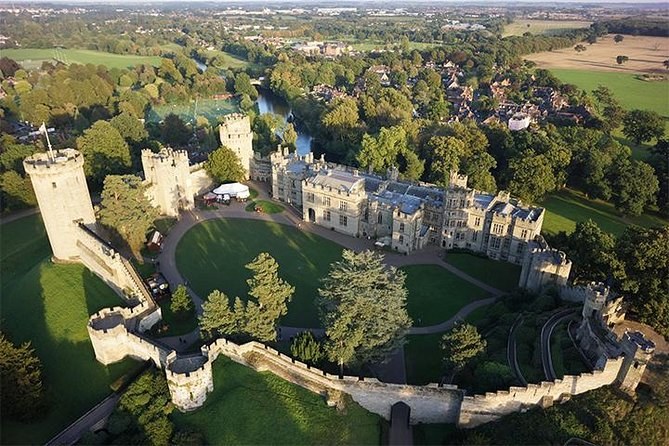
More than most English castles can claim. Caesar’s Tower at 40 metres and Guy’s Tower at 29 both date from the great rebuilding funded by Thomas Beauchamp, Earl of Warwick from 1329 to 1369, out of ransoms taken in France. The curtain wall between them and the gatehouse and barbican of the East Front belong to the same programme.
Under all of it is the motte William the Conqueror raised in 1068, which you climb by 122 steps and which is the oldest thing on the site apart from the ground plan itself. The town’s defences are older still, dating to the burh of 914.
Did you know? Warwick was besieged twice and taken once, in 1264. It held in 1642, which is why so much of the medieval fabric is still standing — comparable castles that fell in the Civil War were slighted afterwards and are ruins today. The full history has the sequence.
What is Victorian, and honestly labelled
The Great Hall is the important one. Fire destroyed it and the private apartments in the early hours of 3 December 1871, and what a visitor walks through today is a Victorian rebuild inside the medieval shell. That is not a criticism — it is a nineteenth- century restoration of real quality — but it is not the room Richard Neville knew.
The grounds are Victorian in effect and Georgian in origin: Capability Brown re-landscaped them between 1749 and 1757, and the reason the courtyard reads as a composed view rather than as a working bailey is that he composed it.
What is staging
The Royal Weekend Party sets the private apartments as a house party given by the Countess of Warwick, with wax figures for the guests. The Kingmaker walks you through a medieval household arming for battle. Both are interpretation rather than fabric, and both date from the castle’s life as an attraction after the Tussauds Group bought it in November 1978.
They are also, on their own terms, good. The Kingmaker in particular does something a label cannot, which is convey how many people it took to get one man onto a horse.
Which is which, at a glance
| What you are looking at | Date | Fabric or staging |
|---|---|---|
| The mound (Conqueror’s Fortress) | 1068 | Fabric |
| Caesar’s Tower | 14th century | Fabric |
| Guy’s Tower | 14th century | Fabric |
| The curtain wall and rampart walk | 14th century | Fabric |
| The East Front gatehouse and barbican | 14th century | Fabric |
| The Great Hall interior | After 1871 | Victorian rebuild |
| The grounds and sight-lines | 1749–57 | Capability Brown |
| The Royal Weekend Party | After 1978 | Staging |
| The Kingmaker | After 1978 | Staging |
| The Castle Dungeon | Modern | Staging, and an extra charge |
How to have the historian’s day
- Start with the mound. 122 steps, and it puts the whole site in chronological order before you look at anything else.
- Then the wall walk. 540 steps between the two towers, and the best surviving fourteenth-century military architecture on the site.
- Catch a History Talk. Free, run by the castle’s own staff through the day, and the only guided element here. The shows page has when they run.
- Walk out to the Collegiate Church of St Mary. Six minutes from the gate. The Beauchamp Chapel holds the tomb of the earl who paid for your towers.
What to skip, and what to skip it for
If your day is short and the building is what you came for, the Zog programme and the Horrible Histories Maze are not for you and there is no need to feel bad about that. Spend the time on the mound and the wall walk instead. If you have children with you, the reverse is true and the theming is doing exactly its job.
The five families, and why that matters to what you see
Warwick passed through five families as earls — Beaumonts, Beauchamps, Nevilles, Dudleys and Grevilles — and each left a different kind of evidence. The Beauchamps left the building itself: the towers, the wall, the gatehouse. The Nevilles left the reputation, in the person of Richard Neville, whose two kings are the reason the name carries outside Warwickshire.
The Grevilles left the contents. They held the castle from 1604 to 1978 — 374 years — and that is why the state rooms are furnished rather than swept. Almost every English castle of this age is either a ruin or a museum piece; this one was still somebody’s house within living memory, and that is genuinely unusual.
Reading the fire damage
Once you know about the fire of 3 December 1871 you start seeing it. It began in Lady Warwick’s apartments above the library, east of the Great Hall, and it took the hall and a run of private apartments and offices with it. What went back up is careful, expensive Victorian restoration work in the medieval shell.
Look for the joins. The exterior walls and the tower stair turrets are fourteenth century; the hall roof, the panelling and most of what hangs on it are not. Neither half is pretending to be the other, and the castle has never claimed otherwise — it just does not put a date on the wall for you.
If Warwick is not what you want
Then Kenilworth Castle is fifteen minutes away by car and is the other proposition entirely: an English Heritage ruin with Elizabethan garden reconstructions and almost no interpretation staging at all. Visitors who find Warwick over-produced usually find that Kenilworth is the castle they had in mind. Heritage nearby has the distances.
The honest verdict on Warwick is that it is a genuinely important medieval building running a commercially successful family attraction inside itself, and it does not hide either half. Warwick Castle Tours sets out every way in, including the days that reach it from London with the journey handled.
The fourteenth century is still standing here. It just has a gift shop now.Every listing here refunds in full at 24 hours’ notice.
See Top ToursDays built around the building rather than the show
Blenheim palace Shakespeare Warwick Castle Private Tour with pass
Castle entry includedBlenheim entry includedShakespeare's Birthplace included
From $818 per person